
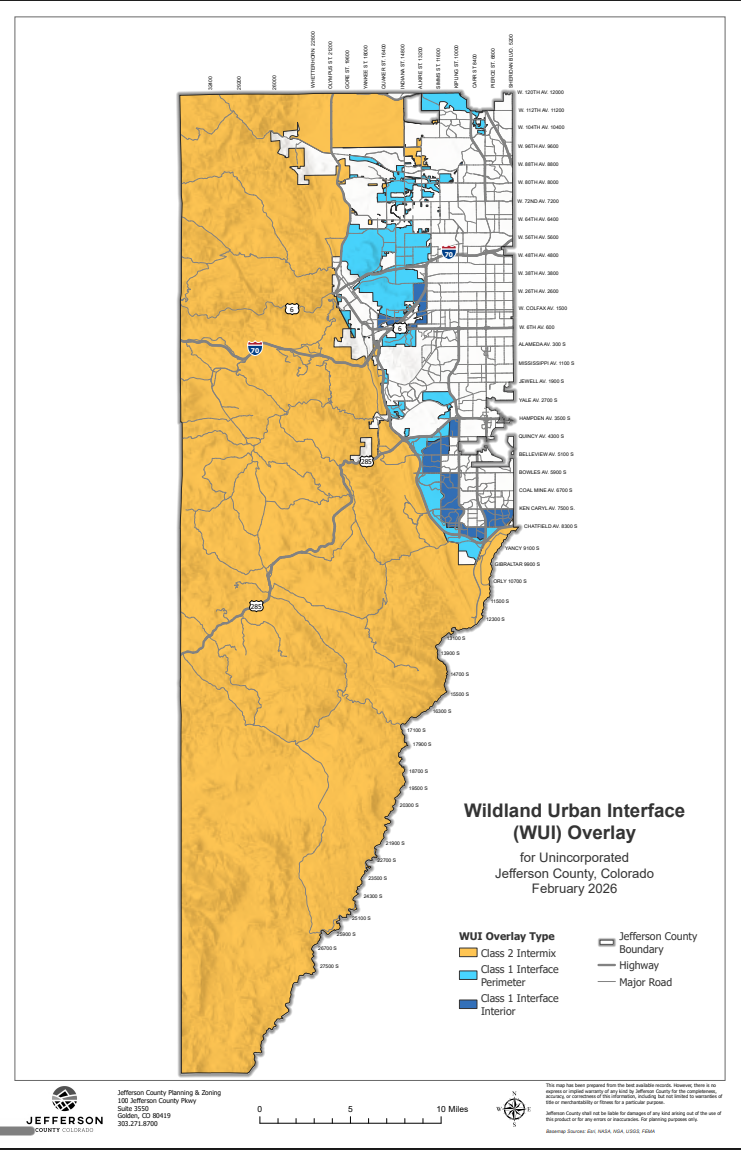
Am I in a WUI area?
How to check whether your Colorado home sits in a mapped Wildland-Urban Interface area, which map governs your roof permit, and how ground truthing works.
Read the guideColorado Wildfire Resiliency Code
Colorado adopted its first statewide wildfire building code, the Colorado Wildfire Resiliency Code, on July 1, 2025. It is not retroactive. It reaches an existing home when you replace the roof covering, or 25% or more of the roof surface, at which point the whole roof has to meet Class A with compliant valley flashing, noncombustible gutters and ember-resistant vents. It applies only inside mapped Wildland-Urban Interface areas, and enforcement is local.
Colorado's wildfire code is a state minimum, but adoption and enforcement happen locally, and adoption is uneven. Some counties, towns and fire districts adopted the code, some adopted amended or more stringent versions, and some declined. Nothing on this page tells you what applies to your specific address. We confirm the current adopted code and map with your building department before every project in a wildfire area, and we put the answer in writing with the estimate.
Each guide below answers one question homeowners actually ask us, with the code section behind the answer.
How to check whether your Colorado home sits in a mapped Wildland-Urban Interface area, which map governs your roof permit, and how ground truthing works.
Read the guideReplacing 25% or more of a roof in a mapped Colorado WUI area brings the entire roof to Class A new-construction standards. What triggers it, what is exempt, what to demand in a bid.
Read the guideWhat a Class A fire rating means under ASTM E108 and UL 790, why some materials earn it alone and others only as a tested assembly, and why documentation matters.
Read the guideAsphalt, metal, concrete and clay tile, slate and synthetic shake compared for Colorado wildfire areas, with how each reaches Class A and what it costs installed.
Read the guideWood shake cannot meet stand-alone Class A, so it is effectively disqualified in mapped Colorado WUI areas, and several jurisdictions banned wood roofs outright years ago.
Read the guideMost homes lost to wildfire are ignited by wind-blown embers, not flame contact. What Colorado's code requires of vents, gutters and valley flashing, and why it matters most.
Read the guideHow documented roof mitigation affects Colorado wildfire insurance under HB25-1182, what the FAIR Plan covers, IBHS Wildfire Prepared Home, and the state mitigation tax credit.
Read the guideColorado's wildfire code is enforced locally and adoption is uneven. How the deadlines worked, which jurisdictions moved early or declined, and why you must confirm your address.
Read the guideAnswers to common homeowner questions about Colorado's Wildfire Resiliency Code: the 25% reroof trigger, Class A roofing, ember-resistant vents, insurance and what to ask your roofer.
Read the guideWe confirm the adopted code and map with your building department, answer the 25% question in writing on the estimate, specify the vents and valley metal as standard scope rather than upsells, and hand over the assembly documentation so you have a mitigation file for your insurer. If you are weighing materials, our residential roofing options page covers what we install, and the neighborhood guides cover the foothill areas where this code bites hardest.
Tell us what the roof is doing and we will tell you honestly whether it needs a repair, a replacement, or nothing at all yet.